Unzip the VST file. Copy the.dll file to your VST plugin folder. This folder may be named differently for you. In FL Studio click Channels up top and click the Refresh button to scan your VST plugin folder. Look for the new VST plugin you added and check the box next to it. I have a folder on my C: Program Files called 'VST Plugins' and that's where I keep the actual DLLs and I do so by having separate 'vendor' subfolders. This is mostly for easy organization and updating. Others put all their program files and actual VSTs on a separate drive. These would include documentation files and other files related to the installation, but not the actual VST DLLs. I have a folder on my C: Program Files called 'VST Plugins' and that's where I keep the actual DLLs and I do so by having separate 'vendor' subfolders. This is mostly for easy organization and updating. As the VST2 standard does not know a dedicated installation folder, VST2 plug-in installers usually let the user select an installation path. But VST2 plug-ins can also have a fixed installation path predefined by the manufacturer. In this case, only the documentation can tell you where to find the plug-in. Musical Gym wroteI installed SampleTank 3 in my 64 bit vstplugins folder, but S1 does not show it in instruments list even after refresh.Most of my plugins are dll files, but ST3 is a.vst3 file. When installing VST plugins there are typically 3 things to manage: - The main files and folder which will be documents and program files. The VST plugin file (This is the plugin you can place in a convenient location for music software to access) - Library files (content that provides the sounds such as sampled audio libraries). Virtual Studio Technology (VST) is an audio-plugin that integrates a software synthesizer or effect with, most commonly, a digital audio workstation like Ableton. External plugins can increase the functionality of your DAW by allowing you to use new or different instruments, effects,.
As a total newbie to Mixcraft 8 I watched all the videos on the official channel and I have learned a lot how to use the program but there is one thing that I am not sure about at present.
How do you scan your plugins in Mixcraft? What folder does your plug ins reside in?
I have Sonar X3 in my system and the plug ins for that reside in a folder called Cakewalk/Vst/Plugins. Something like that.
Sonar automatically creates this folder when you install it. You don't have to use it of course but I do. All your plugins reside in that folder unless you chose to assign them to another folder.
I have Mixcraft 64 bit and 32 bit installed on my Laptop. Mixcraft is letting me use some of my cakewalk plug ins in mixcraft. It seems to be letting me use 32 bit Cakewalk plug ins in Mixcraft 32 bit and some other 64 bit plugins I have such as Addictive Drums in Mixcraft 64 bit.
When I want to install an external VST in Mixcraft where do I put them. Is there a special folder? How does Mixcraft basically know where to look for your external VST plug ins. I didn't see anything about specifying a folder for VST plug ins during installation.
Thanks SteveHi,
I can't find this problem reported elsewhere ...
Observed behavior :
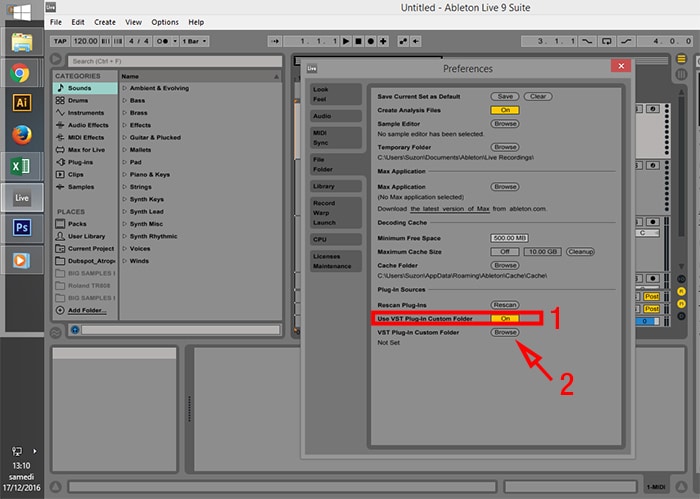
The 32-bit version of Live 8.3.4 is installed and authorised. The plugins folder is set to:
At this point installing and running Live 8.4b7 for the first time defaults the plugin folder to the same location, which won't work because the folder typically only contains 32-bit plugins.
Expected behavior :
A sensible solution would be to use the folder configured for the 32-bit version, but remove the ' (x86)' part if it exists.
Variables :
n/a
Did you see this error more than once?
This happens every time I restore a partition containing Live 8.3.4 and then update to the current Live 8.4 beta.
Can you reproduce this error on a second computer or on another platform?
See above
Can others reproduce your problem?
 Don't know.
Attachments:
n/a
Peace,