Product Description: Tone Generator; 30 – 10000 Hz; Sine, Saw, Triangle, Square, Noise; Bandlimited signals; Free; Windows VST 32/64; Mac AU 32/64. Mac: LCAST comes in three versions on the Mac: an AAX plug-in for Pro Tools (10.3.7+), an Audio Unit and a VST 2.4 plug-in. All plug-ins are 32/64-bit universal binaries. Windows: LCAST is available as a 32/64-bit AAX plug-in for Pro Tools (10.3.7+) and a VST 2.4 plug-in on Windows.
Crossfeed and EQ for headphones
 Crossfeed
Latest note : I did a similar software that is available here : head-fit
Some parameters are the same but head-fit is more flexible, has some process improvements and is a bit more oriented to headphone optimisation.
This plugin’s purpose is to help you to find the best settings for headphone equalization and crossfeed adapted to your own ears.
Don’t be afraid by all the sliders and buttons on the picture : it’s easy to use, just read this page.
Vst plugin z3ta+. Some tips about installation and fuctions can be found here.
If you get no sound out, you may have to choose engine input and output assign and device/wave.
Set volume level to a low value.
Set generator to wav and play some music you like.
Adjust volume to a comfortable level
Now pan completely to left or right and click on/off the crossfeed button.
In few words : you shouldn’t hear any difference with a mono record but a huge difference for sounds recorded only on one channel, and in between,with most records, the crossfeed effect is subtle but nice, giving some extra “space”.
After you can fine tune and adjust other parameters and the EQ.
Delay is the time delay between the ipsilateral signal and the contralateral one.
Note : in this program, the sum of ipsi and contra is +3dB for correlated signals and 0dB for uncorrelated signal. Music beeing in between, it may give a small bass rise of 1 to 2dB because recordings are generally more correlated in low frequencies.
Also take care about elevation, that means that the sound should not come from above or under but ideally at the same height as your head. It can be quite long to get best results. But, I think, it’s worth of it.The spatialization will dramatically improve : crossfeed should avoid most of the typical “in the head” feeling.
– with or without crossfeed, the tonal quality (timbre) should not really change, check this listening to uncorrelated pink noise.
When you compare different crossfeed processes, test with correlated and uncorrelated pink noise, there should be highly audible difference of timbre with or without the crossfeed process.
– I invite Rockbox users that have crossfeed enabled to also set precut (it’s a parameter in the EQ settings) to -3dB (because crossfeed may give a max boost of 3dB in the bass). With this precut value, you avoid any risk of overloading even with records mastered to stupid levels very near of 0dBFS. Moreover, if you also use EQ with some boost, set precut value to the sum of crossfeed max gain (3dB) plus max Eq boost (for me it’s 2dB, see my curve hereunder at highest frequencies) that gives a total precut value of -5dB.
Note : I’m really wondering, when you linearize identiqually the frequency response of two (good) headphones, of what remains as a difference ? distortion, comfort ? (go to my earphone page)
- Pink correlated is the same pink noise in both left and right channels. Though headphones, you should hear the noise in front of you.
- Pink uncorrelated is for the same kind of noise but different in each channel, this is more like real sounds or music . It brings a more spacious sound. This can be useful to test for any coloration the crossfeed function may bring : with/without crossfeed, the tonal quality should change as little as possible.
- Pink corr. filtered is a correlated pink noise but bandpassed filtered near critical bandwidth. The center frequency is set by the generator frequency slider.
- Bonger is also a kind of pulsed sinus (with few harmonics), you can change its frequency so it’s also usefull to setup crossfeed : you can try with a low and a higher frequency and try to keep sound coming from the same angle.
The show/hide button displays a list of all actual values so you can set your Rockbox configuration file. You can also save/load setups using the VST presets.
7) Measure the results
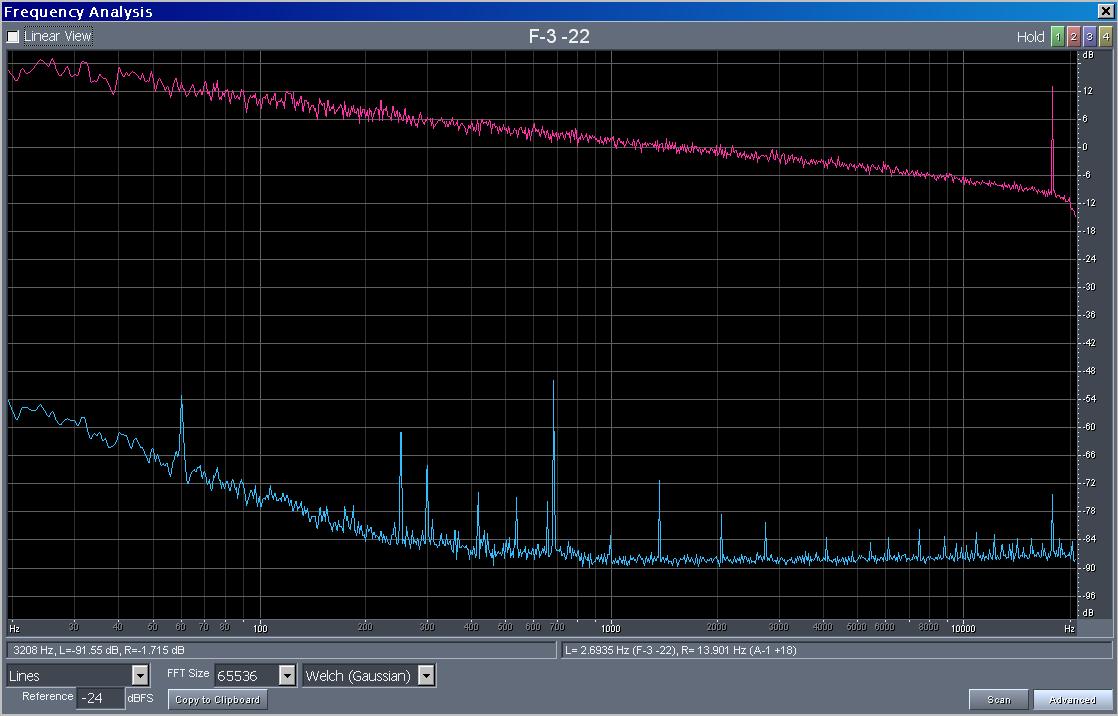
After having found your best setup, you may have a look at the resulting frequency response with VST Plugin analyser from C.Budde (look in his programs page). When you open a file in the analyser, choose the plugin file : crossfeed_eq.dll.
Don’t worry about the frequency warbles in crossfeed mode : it’s not the frequency response of a channel but it results from adding the two channels with a time difference that gives a kind of comb filtering (ipsi and contra signals add or cancel at certain frequencies).
So measure the crossfeed and the EQ separately.
If you have any fear of this ripples, just do following test : set input to mono and with the crossfeed on/off, try to hear the differences.
This is the frequency response of the crossfeed function with default values (no EQ) :
Here also the compared RMAA measurements through the software process (default setup and EQ lowshelf= 1.5dB, 500Hz) :
What do you do when you’re looking for cool ways to come up with unique bass lines, leads, and melodic motifs?
Use an arpeggiator.
Free r&b sound vst plugins. TAL NoisemakerThis noisemaker synth proves that VSTs do not need to be complicated to work well on a track.It is quite a straightforward synth and has a sturdy, compact, and sound, along with a lightweight interface.It T5is equipped with a visual editor, which are unique and handy onboard effects, which also includes TAL's and ‘ emulation of the Juno chorus effect.Check it out.
The best arpeggiator VSTs are capable of so much more than just cranking out static, repeating lines. Free dark piano vst.
If you haven’t looked into the capabilities of the current crop of arpeggiators yet, you are in for a treat!
So this post will take a look at some of the best arpeggiator plugins on the market.
Top Arpeggiator VST Plugins
1. Cthulhu by Xfer Records
Demo & Price
Cthulhu comes from the same maker of Serum, that beast of a synth. Likewise, “One Note Becomes Many” is the intriguing tagline that greets you at Cthulhu’s product page, and it does provide an accurate description of the capabilities of this unique plug-in. Is it an arpeggiator, an instrument, or an audio processor? Like the best arpeggiators, Cthulhu is all that and more.
What Cthulhu primarily does is transform inputted chords in many interesting ways. A versatile and easy to use tool, it encourages the creation of chord progressions and musical motifs that you wouldn’t have come up with otherwise.
Specs and useful features
Although Cthulhu does a great job as an arpeggiator, it is first and foremost a chord recorder/player. This function enables you to come up with plenty of interesting chord variations by pressing single keys on your keyboard. You can play chords right into the plug-in or import chords and progressions in MIDI format.
Cthulhu is equally capable as an arpeggiator, enabling you to transform notes and chords that you input into different rhythmic variations. With no less than eight tabs in the step sequencer, you have ample options for reshaping incoming notes. Even single note lines can result in complex and uniquely memorable riffs.
User impressions
You don’t a lot of musical knowledge to come up with complex and musically interesting motifs with Cthulhu. The chord memorization feature alone is well worth the price tag, and having a very capable arp onboard makes it an even better deal.
Literally dozens of interesting variations can spring forth from even the most basic note sequences. Whether as an idea generator or a way to reinvent tired, old melodic motifs, Cthulhu has the power to consistently surprise.
Bottom-line
A chord generator and arp rolled into one, Cthulhu is a powerful creative tool no matter how you look at it. If your creative well has run dry and you need a source of inspiration, this plug-in definitely gets the juices flowing.
2. Kirnu Cream by Arto Vaarala
Demo & Price
Kirnu Cream took the MIDI world by storm when it was released in 2013. The hype and speculation had been building up to a fever pitch for months before then, and the official release proved to be everything that everyone had hoped for and then some. Cascading arpeggios, sequenced patterns, and ear-catching chord memory progression–all these issued forth from the revolutionary plug-in, and there were many options for modulating the results as well.
Cream today remains largely unchanged from its initial version, which is a testament to its design and functional excellence. Whether used for arpeggiators, lead and bass lines, and even beats, Kirnu Cream is pretty much peerless.
Pink Noise Plugin Vst Plugin
Specs and useful features
Cream has several features that make it as suitable as a live instrument as a studio tool. The arpeggiator is what most people will probably be drawn to. But it also has one of the most powerful pattern sequencers around, with excellent chord memory features added to the mix. Pattern data can be selected and manipulated freely, with four tracks and loopable pattern controls. These features give the plug-in a great deal of flexibility for reimagining melodies and musical phrases.
Amazingly, Cream is very easy to learn and put into use. You didn’t have to dig too deeply into its inner workings to come up with cool motifs, although there is considerable power under the hood for more in-depth tweaking.
User impressions
The many opportunities for direct interaction are what most users appreciate the most about Cream. It goes beyond the capabilities of most arpeggiators and pattern sequencers, producing musical and creative results with very little effort. Many users especially like the “arpeggio on note count” feature, which keeps the arpeggiator from starting up until a specific number of notes are played. This feature makes it possible to combine standard melody lines with arps in a musical manner.
Bottom-line
With so much power onboard, you would expect Cream to be difficult to use. While you will have to do a bit of fiddling around to unlock its full potential, this never gets in the way of its sheer power and capability.
3. Thesys by Sugar Bytes
Demo & Price
Sugar Bytes is known for its plug-ins that serve as creative instruments and unique audio and MIDI processors. Thesys is a prime example, covering many of the company’s strengths in an intriguing step sequencer that is also a pretty kick-ass arpeggiator.
Thesys utilizes the venerable–and still-popular–step-programming paradigm in enabling you to manipulate your music in various interesting ways. Whether for heading off into uncharted musical territory or simply breathing new life into tired, old material, Thesys provides a direct path to creative musical expression.
Specs and useful features
Unlike other plug-ins that lock you into a specific way of working, Thesys lets you work the way you want to work. You could paint in sequences with your mouse, which is a fast and intuitive way of working. If you prefer a more traditional approach, you could input notes from a MIDI keyboard. There is a built-in synthesizer for this purpose, letting you hear inputted notes and the resulting sequence without having to patch in a third-party synth plug-in.
The Randomizer is an especially useful feature, helping you avoid the predictability that often results from step-sequencers and arpeggiators. With this feature, you can come up with interesting variations of your melodic material or head off into wild and wonderful new directions.
The Velocity and Gate Sequencer sections are where you will likely do most of your tweaking. These sections let you finesse riffs and arpeggios into impressive musical phrases without a lot of fiddling around.
User impressions
Thesys delivers far more capabilities than your average arpeggiator plug-in. Users found it to be just as useful live as in a studio setting. This is one plug-in that cranks out more than what you put in, and many users find it a sheer joy for livening up drab MIDI passages.
Bottom-line
Thesys is more than just an arpeggiator or a step sequencer. It is practically a full-blown MIDI workstation, and its sheer power and flexibility will definitely win you over.
4. Consequence by Sugar Bytes
Demo & Price
Consequence is Sugar Bytes’ simpler offering in the arpeggiator category, but it is still pretty capable at transforming inputted notes in interesting new ways. It creates note sequences based on chords that you play in, with numerous options for interpreting the incoming data.
You can load up to three instruments into Consequence, each of which has its own envelope. You can play these instruments via the onboard 32-step sequencer and create very complex rhythms and textures pretty easily. There is even a multi-fx unit onboard for adding extra spice to your creations, and a four-on-the-floor kick drum pattern that helps you keep your grooves locked tight.
Specs and useful features
The chord sequencer is where most of the action takes place. Here, you could store up to 16 chord “snapshots”, and trigger them in any combination you please. The results are never static, with five sequencers enabling you to control various aspects of the groove. There is also a comprehensive modulation section that provides even more options for controlling the three synthesizer parts, the filter, and the FX unit.
As an arpeggiator, Consequence is about as versatile as they come. You can set each of the sequencer steps to “Arp”, “Chord”, “Octave”, or “Tie”, enabling you to go well beyond the capabilities of most arpeggiators. You can even control the play direction in various ways, which lets you create pretty impressive melodies from even the most basic motifs.
User impressions
Consequence strikes many users as a fun and inspirational alternative to most standard arpeggiators. It is especially appealing to those looking for a fresh and creative approach to coming up with melodic ideas. For many users, Consequence has proven value as a songwriting and production tool.
Bottom-line
Like most Sugar Bytes plug-ins, Consequence provides a unique way of working with source material. Even if you already have a well-spec’d arpeggiator in your arsenal, Consequence is still worth adding to the pile for its unique workflow.
5. Audiaire Nuxx
Demo & Price
On paper, Audiaire Nuxx looks pretty intriguing. Billed as a multi-FX processor with an onboard parameter sequencer, it seems like a handy solution for livening up static sounds and sequences. But digging deeper into its features reveals a very capable processing tool that can twist and warp audio in many creative ways.
Useful Features
Audiaire Nuxx essentially lets you modulate up to three parameters of six effects at a time via macro controls. There are 30 effects on-board, including compression, distortion, decimator, chorus, delay, flanger, two flavors of phasers, high, low, and band-pass filters, and more.
Nuxx has a slick and modernistic interface, with all the sections laid out clearly for ease of use. The GUI is scalable and comes with a variety of lane modification tools. The plug-in’s unique interface makes it easy to manipulate sounds quickly and easily and even perform detailed audio editing.
Nuxx can be set up to work as a simple effects unit, with the sequencer bypassed and hidden out of sight. But inputting different values into each step of the sequencer is what truly unlocks the plug-in’s sonic potential. With 27 lanes, independent sequence lengths, step mutes, swing, and probability controls, you have plenty of leeway to mangle your sounds.
User Impression
Users love the sheer variety of sounds that are possible with Audiaire Nuxx. Although it works well enough as a filter and distortion unit to add warmth to cold digital tracks, it especially excels at creative modulations of the 30 effects processors. A potent sound-design tool, Nuxx is also useful for coming up with fresh and inventive ideas when inspiration runs dry.
Modeled after Yamaha DX7, one of the best selling synths in history, this top 1 free FM-style VST synth is ready to get you cooking. Included are over a thousand classic DX7 presets, with sounds ranging from. Vember Audio Surge is probably the most powerful free VST synth on this list. Surge is open source which means you’re free to download the code and do whatever you want with it. Welcome again to the Editor`s choice of the 9 most Amazing FREE VST Synth Plugins! We made an effort in making a list of 9 high quality free VST synth plugins you can download and use right away. Oxe FM by Oxe Music Software Oxe is a really cool FM synth. Get the 200 best free VST plugins ever made. From synth VSTs and drum VSTs to VST effects, this huge list has only the best of the best plugins. Free synth vst fl studio. If there is one free VST synth that you want to get yourself familiar with, it is the Synth1 by Ichiro Toda. This synthesizer is actually a favorite among many music producers, and is often the one that’s most recommended. Synth1 is an analog modeled subtractive synthesizer.
Bottom-line
Audiaire Nuxx is a simple but surprisingly powerful audio processing tool. Ideally suited for creative sound design, it is made especially useful by the inclusion of some excellent effects with well-thought-out control over the most important parameters. Its onboard sequencer lets you cook up some outrageous and wacky sounds, from liquid filter burbles and rhythmic delays to wild pitch squeals and grinding distortion, and more. Not your garden-variety arpeggiator, Audiaire Nuxx is a hugely entertaining sound design tool.
Bonus Mention: Numerology 4 Pro by Five12
Info & Price
Numerology is something of a dark horse in the music production world, attracting an almost fanatical army of devotees. But it offers a totally different approach to idea generation, programming, and music production.
You could certainly use Numerology merely as an arpeggiator if you wish, even at this comparatively basic task. But its features makes it more of a complete music production solution than a mere arpeggiator plug-in.
Specs and useful features
Pink Noise Generator Vst Plugin
Numerology is essentially a modular system, providing several options for sequencing audio, MIDI, and even control voltage (CV) signals. The matrix sequencer is your ticket to arpeggios, although you could certainly use it for more subtly melodic material if that’s what you need.
One of the best things about Numerology is that you can modulate almost any parameter. Like an extremely well-spec’d synthesizer, you can route anything to almost anything else, in this case to compositional parameters.
Bottom-line
Numerology is a beast of a plugin. Perhaps it is a bit unfair to lump it in with ‘mere’ arpeggiator plug-ins, but it does such a great job at that role that we simply had to add it to the lineup.
About Arpeggiator VSTs
An arpeggiator is a feature found on many synthesizers, vintage and modern, hardware and software. Often referred to simply as an “arp”, it lets you play a string of notes via a single key press or a single played chord. Even when playing a relatively simple phrase, arpeggiators can produce complex and impressive melodies and repeating motifs.
To learn more about what an arpeggio is, check out this Wikipedia entry.
Arpeggiators typically produce characteristic repetitive motifs that serve as the backbone for countless synth-based tracks. Used on such classic rock tracks as The Who’s “Baba O’Riley” and Pink Floyd’s “On the Run”, it is also the most recognizable element in Donna Summer’s seminal “I Feel Love”.
Free Noise Reduction Vst Plugins
In its simplest iteration, arpeggiators simply play back the individual notes of a chord in sequence. In older synths, arpeggiators provided the option to play the note sequence from high to low, low to high, and little else. Many modern arpeggiators provide many more options for setting play direction, note length, and more. With some of the arpeggiator plug-ins reviewed above–and some advanced arpeggiators on hardware synths–the results can be far removed from the typical robotic lines of a primitive arpeggiator.
Free Vst Noise Gate Plugin
All arpeggiators are able to play back the notes in a held chord. But more advanced arpeggiators can store note patterns, and even chords, providing you with even more options to come up with fresh and inventive parts. Some even allow for layering of different arpeggio patterns, polyrhythms, and random triggering. When you add the capability to modulate the output in many different ways, there is no reason why arpeggiators should simply be relegated to churning out basic, repeating lines.
For the moment, the patch sockets have no function, because there is no MIDI learn function for these sockets. I placed them for the final look and maybe for later use. https://golcs.netlify.app/ace-vst-plugin.html. To see more unique DIY MIDI controllers and catch up on Jurisch's progress with the ACE, head over toHere are some words from Jurisch about the new controller.' About 90 knobs, eight Sliders, six switches and joystick to control the most important parameters of the software.' The ACE Controller has a three octave keyboard with velocity and channel aftertouch.
Pink Noise Generator Plugin Vst
At the very least, you will want an arpeggiator that gives you a few different options for playing back notes. Extensive modulation options are also good to have, as is the ability to send the note data out as MIDI.