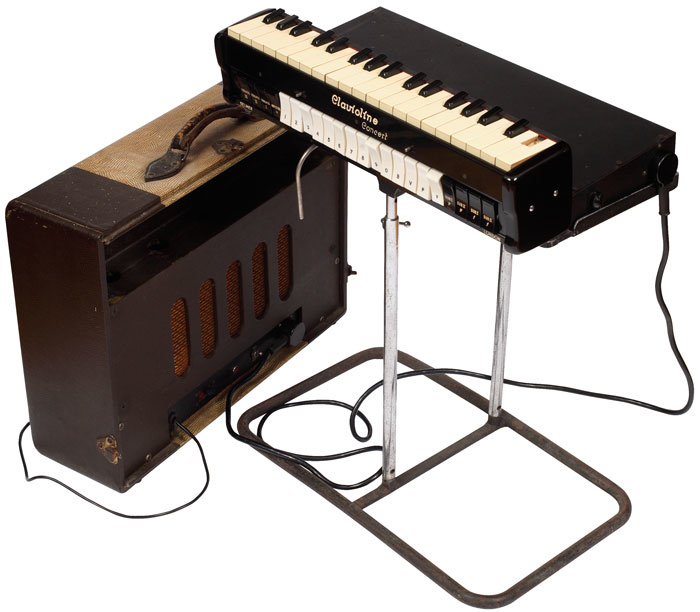
Although not the first electronic musical instrument, the French-made Clavioline has one of the most recognizable sounds of all such instruments. Developed in France by a designer named Constant Martin, it was introduced in 1947 and sold until about 1960. The Clavioline consisted of two units, one a simple electronic organ with just 22 keys, and a small range of customizable sounds, modifiable by setting a series of more than a dozen switches. The second unit consisted of a public-address amplifier and loudspeaker. The synthesizer circuits inside the instrument were tailored to produce a range of “brass” and “string” sounds that vaguely resembled true horns and stringed instruments.
The Clavioline had a commercial history shared by a number of electronic instruments. It was common in those days for instruments offered by one company to be distributed, or even manufactured, by other firms around the world. In addition to French and German manufacturers, the Clavioline design was also made and distributed by the American guitar maker Gibson in the 1950s. This dispersion resulted in the Clavioline being repeatedly adapted or modified over the years. Various engineers or companies added features such as circuits to expand the instrument’s range of tones, or to allow it to be added to conventional pipe organs.
In the late 1950s and into the 1960s, the Clavioline was featured in a number of hit songs from artists ranging from the Beatles to Del Shannon. It was Shannon’s organist Max Crook in particular who spurred the evolution of the Clavioline. Beginning in 1959, he added numerous special sound effects to the basic instrument, giving it the ability to produce new sounds as well as weird echo and reverberation effects. The resulting device was so different from the original Clavioline that Crook renamed it the “Musitron.” A later version called the Sonocon, created by Crook and bandmate Scott Ludwig, included electronic percussion sounds and a mechanical “tone bender” that allowed the musician to manually change the pitch of the sounds being played. Featured prominently in Del Shannon’s “Runaway,” the little Clavioline warbled its way into music history. The Clavioline was also featured on the Tornados intrumental tribute to the first communications satellite, 'Telstar.'
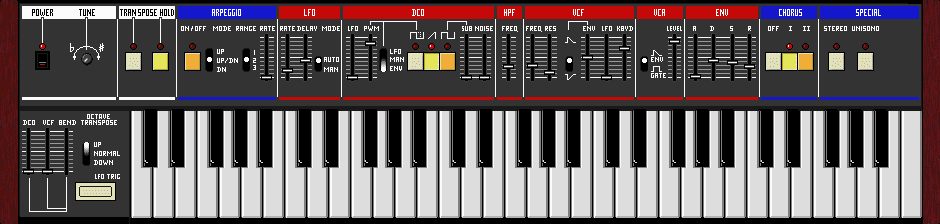
The Clavioline achieved its attenuation in a number of ways. According to the same Selmer manual that taught people how to make their Clavioline sound like a sousaphone, part of the instrument’s secret was its valves, or tubes as we call them here in the States. “With a good Clavioline. There are 3 ways to play notes: Click or tap the onscreen keyboard. Play with the bottom two rows of keys on your computer keyboard (z, s, x, d, c, v, g, b, h, n, j, m, etc.). Search for best VST Instruments Plugins with many presets for Ableton, FL Studio, Cubase. Here you can find guitar, piano, saxaphone and other kind of plugins.
<flash>file=Telstar.swf|width=682|height=410|quality=best</flash>

This entry was posted in VST plugins and tagged clavinet, d6, emulation, freeware on 4 December 2014 by Wavosaur. Post navigation ← 4 Free VSTi emulations of Farfisa Organ 2 Free Arp 2600 VST emu (+.
The clavioline is an electronic keyboard instrument, a forerunner to the analog synthesizer. It was invented by French engineer Constant Martin in 1947 in Versailles.[1][2]
The instrument consists of a keyboard and a separate amplifier and speaker unit. The keyboard usually covered three octaves,[3] and had a number of switches to alter the tone of the sound produced, add vibrato (a defining feature of the instrument),[1] and provide other effects. The Clavioline used a vacuum tube oscillator to produce a buzzy waveform, almost a square wave, which could then be altered using high-pass and low-passfiltering, as well as the vibrato. The amplifier also aided in creating the instrument's signature tones, by deliberately providing a large amount of distortion.[1]
Several models of the Clavioline were produced by different companies. Among the more important were the Standard, Reverb, and Concert models by Selmer in France[3] and Gibson in the United States[4] in the 1950s. The six-octave model employing octave transposition was developed by Harald Bode,[5] and under licensed by Jörgensen Electronic in Germany.[6] In England, the Jennings Organ Company's first successful product was the Univox, an early self-powered electronic keyboard inspired by the Selmer Clavioline.[7]In Japan, Ace Tone's first prototype, the Canary S-2 (1962), was based on the Clavioline.[8]
Recordings[edit]
The Clavioline has been used on a number of recordings in popular music as well as in film. Along with the Mellotron, it was one of the keyboard instruments favoured by rock and pop musicians during the 1960s before the arrival of the Moog synthesizer.[9]
- 'Little Red Monkey' (1953) by Frank Chacksfield’s Tunesmiths features Jack Jordan on clavioline. An earlier recording of the tune by Jack Jordan himself was issued on the HMV label.
- In 1953–54, Van Phillips composed music for the clavioline for the science-fiction radio trilogy Journey into Space.[10]
- In the Bollywood Hindi film Nagin (1954), Kalyanji Virji Shah plays the snake-charmer tune 'Man dole mera, tan dole mere' on the clavioline, under the musical direction of Hemant Kumar.[11]
- 'Runaway' and 'Hats Off to Larry' (1961) by Del Shannon each feature a bridge solo by Max Crook, performed on a heavily modified clavioline that he called the Musitron.[1]
- English producer Joe Meek began recording with a clavioline in 1960.[12] His production of the Tornados' hit instrumental 'Telstar' (1962) features the clavioline or perhaps a Univox,[7] as does the B-side of that single, 'Jungle Fever'.[1] Author Mark Brend states that, while the exact instrument used has long been open to debate, 'there remains a very faint possibility that Meek used a Univox on 'Telstar,' mixed with a Clavioline.'[13]
- The jazz albums The Magic City (1966) and The Heliocentric Worlds of Sun Ra, Volume Two (1966) and Atlantis (1967) by Sun Ra include clavioline.[14]
- The Beatles used a clavioline on 'Baby, You're a Rich Man', which was issued in July 1967 as the B-side of their 'All You Need Is Love' single. John Lennon played the instrument on its oboe setting, creating an exotic sound that suggests an Indian shehnai.[15] In his feature article on the clavioline, in Sound on Sound magazine, Gordon Reid pairs 'Baby, You're a Rich Man' with 'Telstar' as the two seminal pop recordings made with the instrument.[1] The Clavioline that the Beatles used was owned by EMI Studios at Abbey Road in London.
- The Strawbs 1972 album Grave New World includes some clavioline played by their keyboardist Blue Weaver, on the song The Flower And The Young Man.
- The Amon Düül II album Wolf City (1972)
- The White Stripes used a 1959 Univox on their album Icky Thump (2007).[16]
- 'Good Morning' (2012) by BAM
- Darren Allison plays clavioline on William Blake's 'Eternity' by Daisy Bell, from their London album (2015).
- John Barry of the John Barry Seven made a recording called 'Starfire' which featured the instrument, and it was on the 45 single version of his theme for the TV series Fireball XL5. The clavioline was also used extensively on his Stringbeat LP and other recordings of the period.
- A clavioline appears on Mike Oldfield's 2017 album Return to Ommadawn.
See also[edit]
References[edit]
Clavioline Vst Free Download
- ^ abcdefReid, Gordon (March 2007). 'The Story of the Clavioline'. Sound on Sound. Retrieved 26 July 2017.
- ^Brend 2005, p. 34.
- ^ ab'Electronic keyboard, 'Clavioline', metal / plastic, Henri Selmer & Co Ltd, London, England, 1950-1965'. Powerhouse Museum. Registration Number: 2004/116/1.
- ^Nelson, Philip I. 'Gibson Clavioline Keyboard Instrument (1953)'. Phil's Old Radios (antiqueradio.org).
- ^Bode (6 octave) Clavioline (photograph). Clavioline.com. 2002. Archived from the original on 2006-08-21.
- ^Windler, Christian Oliver. 'Jörgensen Electronic Clavioline'. TableHooters, warranty void (weltenschule.de).
- ^ ab'Vox Electronic Organs'. Music Soul (reinout.nl).
- ^All About Electronic & Electric Musical Instruments (in Japanese). Seibundō ShinkōSha. 1966. p. 32, 34. ASINB000JAAXH6, 電子楽器と電気楽器のすべて.
- ^Holmes 2012, pp. xviii, 448.
- ^Interview with Charles Chilton, Round Midnight, BBC Radio 2, 1989
- ^Nardi, Carlo (July 2011). 'The Cultural Economy of Sound: Reinventing Technology in Indian Popular Cinema'. Journal on the Art of Record Production (5). ISSN1754-9892. Archived from the original on 2013-06-15. Retrieved 2012-03-18.
- ^Brend 2005, p. 47.
- ^Brend 2005, pp. 39–40.
- ^Holmes 2012, pp. 403–04.
- ^MacDonald 2005, pp. 257–58.
- ^Tingen, Paul (October 2007). 'Secrets Of The Mix Engineers: Joe Chiccarelli'. Sound on Sound. Retrieved 26 July 2017.
Sources[edit]
- Brend, Mark (2005). Strange Sounds: Offbeat Instruments and Sonic Experiments in Pop. San Francisco, CA: Backbeat Books. ISBN978-0-879308551.CS1 maint: ref=harv (link)
- Holmes, Thom (2012). Electronic and Experimental Music: Technology, Music, and Culture (4th edn). New York, NY: Routledge. ISBN978-0-415-89636-8.CS1 maint: ref=harv (link)
- MacDonald, Ian (2005). Revolution in the Head: The Beatles' Records and the Sixties (2nd rev. edn). Chicago, IL: Chicago Review Press. ISBN978-1-55652-733-3.CS1 maint: ref=harv (link)
| Wikimedia Commons has media related to Clavioline. |