Download link for 32 & 64 bit are at the bottom of the page at this link. Standin here on the corner of the software forum in his dirty trench coat with all them dvds, download links and dongles hangin on the inside that he flashes at ya ever time ya pass. If nothing else it is fun to play around with. He's one wicked dude. He knows we're hooked and he just keeps on feedin us. Vst plugins guitar harmonizer.
Xfer Records OTT. Xfer Records is notable for their brilliant generation programming, for example. Free vst cello Strings is one of the best free vsts on the internet. Again and again, DSK released free vsti plugins to use for free. After releasing Free electric guitar vst GuitarZ, and then Free Nylon guitar vst. Best free strings vst 2018.
Oscillators
- Best Free 3 Oscillator Vst Plugin
- Free Vst Downloads
- Hybrid 3 Vst Free Download
- Best Free Oscillator Vst
- Best Free 3 Oscillator Vst Download
2 days ago The best free VST synth plugins 1. DiscoDSP OB-Xd (Image credit: discoDSP). The star of the show here, however, is the Chaotic Oscillator, which uses a double pendulum design that can morph between simple sine waves and more unusual oscillator shapes. An animated and customisable UI, MPE support and lots of routable modulation make this a. Insert this vst on two tracks 2. Make the same settings to both, best with 100% pan width fro stereo wide 3. Defase the start pos knob by 50% between them Other solution is by pan offset making tha same value but second with negative value: 75 and -75 on second track. This is best vst for panning your instruments:). To name a few, you now have a fully programmable digital delay, you can control the tuning of oscillator 1 (and fine tune oscillators 2 and 3) and have 3 overdrive sliders for each oscillator to make your sound even thicker. This free synth sounds and behaves pretty much exactly like the original and is a must-have for every electronic producer. Surge is an opensource Synth VST that sounds fantastic and is probably the best synthesizer plugin currently available. It is a hybrid subtractive synthesizer with a dual synthesis engine. Each patch contain two ‘scenes’ which are separate instances of the entire synthesis engine that can be used for layering or split patches.
Blarg's oscillators can be assigned one of six unique modes of sound generation but each of these oscillator types share a set of common parameters which will be explained here.
| TYPE | Selects the sound generation mode from the range A to F. Depending on the type selected, the controls of the oscillator will change accordingly. The six oscillator types and the parematers unique to each of them are described in detail below. |
| SYNC | Restarts the oscillator's waveforms from the beginning of a cycle when a voice is triggered. |
| OCT | Tunes the oscillator's signal by up to three octaves up or down. |
| SEMI | Shifts the pitch of the signal by up to 11 semi-tones relative to the note being played. |
| FINE | Fine tunes the pitch by up to a sem-tone. To lower the pitch slightly, set the OCT control to -1, the SEMI control to 11 and adjust the FINE control to almost maximum. |
| DETUNE | A stereo detuner - this control raises the pitch of left channel channel whilst lowering the pitch of the right channel. |
| SWAP | Reverses the operation of the DETUNE control, so the left channel's pitch is lowered and the right channel is raised. |
| MOD | Modifies the signal in various ways. The effect this control has is dependent on the oscillator's mode selected by the TYPE control. Refer to the description of each oscillator type for further information about this parameter. |
| LEVEL | The volume of the oscillator's output. Note that this parameter can be controlled by any of the available modulation sources, so even if it is set to minimum, the oscillator may still produce a sound. |
| ROUTE | Sends the signal from the oscillator to any of the available modifiers or direct to the instrument's built-in effects, bypassing the filters etc. Oscillators 1 and 2 have an additional Osc RM option in the ROUTE dropdown list. When this is selected, the oscillator's signal will modulate the amplitude of the selected oscillator's output. |
| RM | Selects the ring modulation mode. The different modes are identical to the ring modulator function of the Modulation Oscillator. This parameter is only available for oscillators 2 and 3. |
Type A - Dual Oscillator
A signal is produced by combining two waveforms together in a variety of possible ways.
| MODE | Selects the manner in which wave A and B are combined. |
| WAVE | A choice of 11 different waveforms: SINE, SAW, RAMP 1, RAMP 2, RAMP 3, SQUARE, TRIANGE, PEAK, OCTAVA, CLUSTER 1, CLUSTER 2. |
| HARMONICS | The different waveforms are produced using additive synthesis by combining up to 256 sine waves. The number of harmonics above the fundamental frequency can be reduced here. If the selected waveform is a sine, this parameter will have no effect. |
Availble waveforms:
9 different modes are availble and in each case the oscillator's MOD control performs a different function:
Size 9.27 MB Ukulele is a Hawaiian guitar. Samsara Ukulele is a vst instruments plugins developed by Samsara Cycle Audio, a free Ukulele VST plugins that you can use on any VST Compatible hosts such as Steinberg Cubase, Nuendo, Wavelab. https://golcs.netlify.app/ukulele-vst-plugin-free-descargar.html.
Is well suited for music with good stereo separation and a dry vocal, slightly worse for a wet vocal, and not suitable for mono tracks. Noise remover vst free. However wet vocals can also be slightly muted by narrowing the stereo before processing.Do not expect magic. It works on the principle of “central channel subtraction”, where singer’s voice is usually located.In addition, the plug-in is able to preserve bass and drums, which are also often located in the center of the stereo space and may suffer along with the voice.GLS! Will remove not only the voice: some other musical instruments or sounds may also disappear or become corrupt, and the song loses stereo.
| Output is just Wave A, Wave B is ignored. MOD adjust the phase of the wave. So, provided the oscillator's SYNC button is lit, if the MOD control is set to half-way, the wave will start at half-way through it's cycle when a note is triggered. |
| Wave A and Wave B are added together. MOD adjusts the phase of the waves. |
| Wave B is subtracted from Wave A. MOD adjusts the phase of the waves. If identical waveforms are selected then the output will be silence. |
| Wave A and Wave B are mixed together. MOD acts as a cross-fader between the two waves. |
| Wave A and Wave B are added together. MOD adjusts the pulse width of the two waves. |
| Wave B is subtracted from Wave A. MOD adjusts the pulse width of the two waves. |
| Wave A and Wave B are multipied together. MOD adjusts the pulse width of the two waves. |
| Wave A and Wave B are multipied together and then Wave A is added to the output. MOD adjusts the pulse width of the two waves. |
| The phase of Wave A is modulated by the amplitude of Wave B. MOD controls the depth of modulation. |
Type B - Pulse Width Oscillator
Up to four waveforms, each with indivual tuning and volume, are combined together.
| Selects the number of waves to mix together. |
| Adjusts the rate of simulated analog drift for the oscillator. Lower values produce a more chaotic variation in pitch. |
| Controls the maximum amount the pitch will vary from the base tuning of the oscillator. |
| A choice of 9 different waveforms: PULSE 1, PULSE 2, PULSE 3, PULSE 4, TRIANGE, PEAK, OCTAVA, CLUSTER 1, CLUSTER 2. |
| Selects the number of harmonics which comprise the selected waveform. |
| Tunes the pitch of waves 2,3 and 4 relative to oscillator's base tuning. |
| Adjusts the volume of each wave relative to the oscillator's base volume. |
The oscillator's MOD control adjusts the pulse-width of the waveforms. The effect of this on the different available waveforms is illustrated below:
Type C - Modulation Oscillator
Modifies the shape of a waveform with a secondary waveform using ring modulation, phase modulation or both together. The oscillator's MOD control adjusts the depth of modulation.
| WAVE | A choice of 11 different waveforms: SINE, SAW, RAMP 1, RAMP 2, RAMP 3, SQUARE, TRIANGE, PEAK, OCTAVA, CLUSTER 1, CLUSTER 2. |
| HRM | Selects the number of harmonics which comprise the selected waveform. |
| Tunes the pitch of the MODULATOR wave relative to the SIGNAL wave. | |
| MODE | A choice of RM (ring modulation) where the volume of the signal is controlled by the volume of the modulator, PM (phase modulation) or RM+PM, a combination of the two. |
| RM | A choice of 20 ring modulation algorithms. |
The output produced by the ring modulation function given a sine wave SIGNAL and a sine wave MODULATOR 2 octaves higher:
Type D - Noise Oscillator
A noise generator with a pitch tracking filter. The noise is produced using a sample-and-hold algorithm, whereby a random signal is sampled at regular intervals and the output is fixed at that level for the duration of the interval.
The oscillator's MOD control adjust's the amount of smoothing applied to the output signal, reducing the digital artifacts produced when the signal changes instantly from one level to another.
Best Free 3 Oscillator Vst Plugin
| Controls the sample and hold frequency. Lower values produce a more grainy, digital sound. Higher values more closely approximate white noise. |
| Enables or disables pitch tracking control of the sample and hold frequency. When this is set to On, the frequency specified by the RATE control is added to the oscillator's base frequency. |
| Four filter types are available: low-pass, band-pass, high-pass and notch. Also, the filter can be bypassed. |
| Up to four filters can be chained in series. A higher number produces a steeper frequency roll-off. |
| The depth of resonance at the filter's cutoff frequency. |
Type E - Unison Oscillator
8 detuned waves are combined together. The oscillator's DETUNE control adjusts the range of frequencies the waves are spread across. Perfect drums crack. The MOD control progressively increases the amount by which the waves are out of phase with one another.
| Selects from 11 different waveforms: SINE, SAW, RAMP 1, RAMP 2, RAMP 3, SQUARE, TRIANGE, PEAK, OCTAVA, CLUSTER 1, CLUSTER 2. |
| Selects the number of harmonics of the waveform. |
| Controls the rate of analog drift of the oscillator. |
| Adjusts the amount the pitch will drift away from the base tuning of the oscillator. |
| Positions a component wave in the stereo image. |
| Controls the volume of a component wave relative to the oscillator's overall volume. |
Type F - Spectrum Oscillator
Up to eight sine waves are combined together, each a multiple of the oscillator's base frequency. The level of each sine wave can be specified independently. The oscillator's MOD control morphs the generated signal between two sets of levels.
| Adjusts the phase of the oscillator's constituent waves. Generally this control won't have a noticeable effect unless the oscillator's SYNC button is lit and the sound is being heard in combination with the output of another oscillator. |
| Click and drag the bars to adjust the volume of each of the eight harmonics. Hold shift while dragging for more precise adjustments. |
Free Vst Downloads
However, finding the Chiptune VST best suited for you and your needs can sometimes be a tough task..
The internet is full of information, and, while that’s a good thing, it can also be a little overwhelming when you try to find an amazing chiptune VST.
What you’ll soon realize in this search is that there are many factors to consider.
What starts off as a simple task can turn into one that stretches for days or even weeks.
So, to save you from sorting through them all, we’ve crafted a list of the top 10 Chiptune VST plugins to help you find the perfect one for you.
But before we get into it, what exactly makes a VST ‘the right’ one?
Features To Consider
In this modern day and age, computers are much faster than ever before, but processing power continues to be an issue.
One important thing to consider before purchasing or committing to any VST is what the processing power needs are. Can your computer handle the software that you’re using?
If yes, great! But if it can’t, no worries! You may instead want to look for a more lightweight VST that can do as good of a job as a heavier one.
Aside from processing power requirements, simplicity is another important factor when choosing a great VST to suit your needs.
Do you want to hit the ground running and make chiptune music right away? Or do you prefer to get neck deep in the settings and customize each and every last detail of your sound design process?
Some VSTs will be simple enough to allow you to ‘plug n play,’ whereas others will require a lot more education on your part in order to master chiptune sound design.
When factoring in simplicity, it’s also important to consider the user interface (known as UI). Simple VSTs often have an easy-to-use interface, while the more complex VSTs might be a lot harder to grasp.
This is crucial to keep in mind, because UI can affect creativity, which is extremely important to music production. This is because creativity is influenced by everything you hear, feel, do, or see (UI). So, if you don’t like how your VST looks, it could slow down your efficiency when producing chiptune music.
Lastly, emulation specificity is another big feature to consider. Chiptune music originally was created from gaming systems, such as the NES or Gameboy, with each of those systems producing different types of sounds.
With that in mind, chiptune VST plugins have been created with the capacity to emulate sounds created by certain systems. Knowing what type of sound you want to create will greatly speed up the VST selection process and ensure you use something that you’re happy with.
With these features in mind, let’s get started.
Option 01: Magical 8Bit Chiptune VST
Main Features:
- 5 waveforms - square, 2x pulse, pseudo-triangle, low-res noise
- ASDR envelope settings
- Pitch bend
- Velocity control
- Frequency sweeping
- 32 Voices
Note: For full specifications and download, visit YMCK.
Are you a fan of old, primitive 8 bit game consoles?
If you are, then the Magical 8bit Plug may be the perfect VST for you to make some old school electronic music!
This is because this VST allows for use of the pseudo-triangle or low-resolution noise, which are key when creating 8 bit or chiptune music.
Another important feature about the Magical 8bit Plug is that it focuses on simplicity, which makes creating great chiptune sounds quick and easy.
To top it off, the Magical 8bit Plug is lightweight and will work on both macOS as an audio unit and on Windows as a VSTi.
If you want to see what this VST can do for yourself, check out this awesome animated Youtube video featuring music made by Magical 8bit Plug. It’s set to what appears to be an old school video game.
Option 02: Chipsounds
Main features:
- Hybrid synth/sampling synthesizer
- Control/Modulation/Effects/Mixer tabs
- Arpeggiator
- Wave Sequencer
- Pitch and Amplitude Modulation
- Emulates 15 vintage 8-bit era sound chips
Note: For full specifications and download, visit Plogue.
Looking for something a little more robust than Magical 8bit Plug? Then Chipsounds may be the VST for you.
Chipsounds is one of the more popular chiptune VST plugins this year, and we can definitely see why.
The first reason is because it gives you a lot of control over your sound design process, which is huge when trying to set yourself apart from other producers.
Another cool feature is that Chipsounds can run on both Windows and macOS as a standalone application.
Additionally, it can also run as a VST, AU, RTAS, or AAX plug-in allowing for flexible usage with different systems.
To see this VST in action, check out Plogue’s introductory Chipsounds video.
Option 03: ymVST
Main features:
- Polyphony support
- 3 step arpeggiated chords
- Knobless UI
- Angel sync-buzzer effects
- SID effect
Note: For full specifications and download, visit preromanbritain.
If you’re a fan of the authentic Atari sound, then ymVST is a blast to the past…almost.
To the casual observer, the UI may look complicated. But it was actually made to replicate a traditional non-software music production setting with a more ‘authentic interface.’
This means there’s no knobs or sliders. Yet it also comes with all of the great chiptune quality sounds that can be made by the other more complex VSTs available on the internet today.
So, if you’re used to a more traditional method of chiptune production, ymVST may be right up your alley.
Unfortunately for Mac owners, ymVST is only available for PC users.
Option 04: basic 65
Main features:
- Monophonic synth
- Double arpeggiator
- Mod envelope
- (2) LFOs
- (3) Oscillators
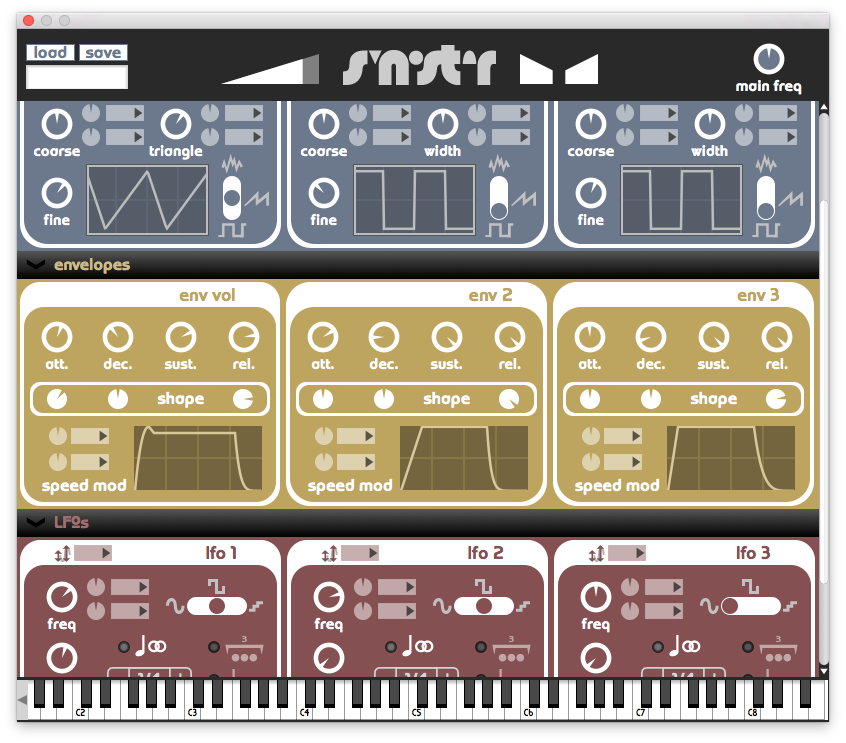 Note: For full specifications and download, visit vst4free.
Inspired by the Commodore 64, basic 65 is a monophonic synth which takes the legendary SID chip from its hardware predecessor and adds more features to ‘take a step further’.
With a clean interface, this VST should be relatively quick to pick up and allow you to get started programming in your favorite chiptune sounds with ease.
Making it even simpler, there are over 128 presets available for you to choose from.
And with the basic 65 being an update to the already popular basic 64, you’ll know that you’re using a VST that has had a lot of prior problems solved.
However, similar to ymVST, the basic 65 is only available for use on Windows which makes that one key detraction in a production world heavily Mac reliant.
Option 05: Super Audio Cart
Main features:
- 5,500+ samples
- 1,200+ factory snapshots
- ‘Hold’ arp steps
- Modulate cutoff & pan with each step
- Use arp steps to modulate other parameters
- Free SNESVerb plugin
Note: For full specifications and download, visit impactsoundworks.
Super Audio Cart provides a revitalized take on an old-school chiptune production scene.
The interface looks modern which makes it similar to other software on the market today such as Omnisphere or iZotope Ozone. In other words, it’s easy to plug n play!
When purchasing, you’ll be capable of replicating sounds from the NES, FC, SNES, GB, 2600, C64, SMS, and GEN console systems. Add in the fact that you’ll receive over 6,000 samples and 630 unique sound sources and that makes purchasing the Super Audio Cart even more appealing.
However, it’s currently priced at $149 through impactsoundworksand also requires Kontakt to run, which can be a problem if you’re on a budget.
Not sure if this is right for you? Take a listen to some chiptune created by Super Audio Cart here to get an understanding of its capabilities.
Option 06: Retro Boy
Main features:
- Subtractive emulator
- Single oscillator
- Vibrato & decimation effects
- Polyphony: 1-4
Note: For full specifications and download, visit sbaud.
As you may be able to tell from the specs, Retro Boy brings you back to the past. For example, it’s extremely lightweight on the processor with only a single oscillator.
It’s a classic, subtractive chiptune VST synth with seven waveforms - 12.5% pulse, 25% pulse, square, saw, triangle, sine, and noise.
Because of its simplicity, most computers should be able to run Retro Boy easily enough making that one of the key highlights of this VST.
And although you could probably figure out Retro Boy’s capabilities quickly enough yourself…
You can also check out a demo before downloading by clicking
Hybrid 3 Vst Free Download
here!Option 07: ICECREAM
Main features:
- Dual oscillators
- 4 Octaves per oscillator
- Amp/Filter ASDR
- Harmonics switch
- Glide and glide rate
Note: For full specifications and download, visit vstplanet.
Are you thinking what we’re thinking? If you are, you’ll understand how cool (pun intended) this VST looks.
It comes with a pretty standard set of features: two oscillators with volume and octave controls, filters, a sequencer, and EQ.
However, what makes this VST stand out is the colorful interface.The playfulness of this interface and color scheme will definitely take you back to the days of playing Super Nintendo as a child.
And even if you haven’t touched a Super Nintendo, you’ll still feel like a kid playing the newest gaming system.
This might jumpstart your creativity and bring your chiptune music to the next level.
To take a listen to all of the creative possibilities that can come about from using the ICECREAM VST, check out this Youtube video.
Option 08: Nintendo VST
Main features:
- Simple UI
- Nintendo emulation
- Portamento
- Pitch bend
Note: For full specifications and download, visit mattmontag
If you want to create chiptune music in the vein of Nintendo using something simple, Nintendo VST may be what’s right for you.
Created by Matthew Montag, the Nintendo VST is lightweight and can quickly be picked up by anyone.
That’s because the volume, duty cycle, pitch, and fine pitch adjustments are easily made with a max of three knobs for each setting (LFO steps, loop point, step time, and tempo sync).
And if you want to understand how the Nintendo VST works, Matthew has you covered! He’s meticulously detailed much of his VST development process on his website.
To see how the Nintendo VST was created, click here.
Option 09: AdLibXRom
Main features:
- Replicates Adlib Music Synthesizer Card
- Two oscillators
- 40 Multi-sampled sounds
Have you ever heard of the AdLib soundcard? If you have, you may find yourself in love with this VST.
The AdLibXRom replicates the sound of the AdLib Music Synthesizer Card which was famous in the early nineties.
Featured within the soundcard was the YM3812 synthesizer chip which utilized FM and additive synthesis.
Today, the AdLibXRom brings things back with the option of using the main or noise oscillator.
Additionally, it features over 40 multi-sampled sounds making usage even more interesting.
Note: For full specifications and download, visit samplescience.
Option 10: 38911 Bytes
Main features:
- Single oscillator
- 4 Waveforms
- 3 LFOs
- 4x16 Step sequencers
To any producer not familiar with Chiptune production, this VST may look a little confusing.
However, if you’ve been around the Chiptune production scene, this may just make you feel at home.
The interface was designed to provide an old-school feel.
Best Free Oscillator Vst
There is only a single oscillator, but it does come with multiple waveforms such as Saw, Triangle, Pulse, and Pitched Noise.Another highlight is the 4x16 step sequencers which also come with 11 different BPM rates.
Has the visual design of 38911 Bytes caught your attention? If so, we’d recommend that you learn more here!
Conclusion
Finding the best chiptune VST to suit your needs depends on your situation and what you’re looking for.
We’ve highlighted some of the best chiptune VST plugins that we think you’ll find particularly useful, each with its own unique characteristics and features.
To reiterate, here are some of the most important features to be aware of when choosing the best chiptune VST for your music production needs:
- Processing power requirements
- Simplicity
- UI (User Interface)
- Emulation specificity
We’ve compiled some amazing VSTs for you to try out and now we want to hear your thoughts!
Have you had any experience using any of these chiptune VST plugins?
Are there any others that we should have mentioned or replaced?
Let us know in the comment section below!